When a Nigerian politician begins to command the angst of fellow politicians, chances are he or she is doing something right. In this political climate, attacks are often the clearest signal that something promising is brewing for such a politician, something the attackers fear might one day blossom into greater success or higher office.
As someone who has followed developments in the Nigerian political landscape since the return of democracy in 1999, I can authoritatively state here that there are three compelling reasons or ways Nigerian politicians usually set out to give their flourishing counterpart the stick.
First, when the person they seek to demonise is doing something right, earning respect and attracting the love of the voting population; their first instinct is to go after his or her good name. It is the classic tactic: give a dog a bad name just to hang it. They try to rewrite a string of successes as failures, to magnify insignificant details into gaping flaws, and to pick holes in methods where there are none.
Second, the motivation is purely political. Here, there is no pretence, no glove hiding the blow. They simply bare their teeth in a flurry of unreasonable claims, driven not by principle but by fear. And the reason is simple: the popularity of the one whose image they want to drag through the mud is soaring, especially in the years leading-up to elections. At this point, the people are beginning to consider such a name for higher office, and the rivals begin panic.
Third, and perhaps the most subtle, is when such a politician begins to build networks beyond the usual silos, demonstrating results that threaten the old order. They are seen as too independent, too successful, or too connected, and that unsettles those who have grown comfortable feeding off the failure of the system.
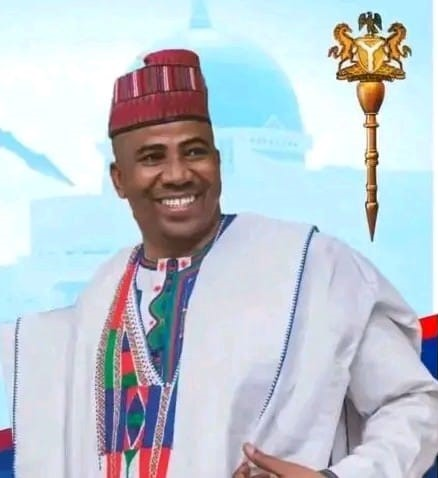
All of these scenarios are currently playing out against Senator Shehu Umar Buba, Chairman of the Senate Committee on National Security and Intelligence. From what I gathered, much of the smear campaign against him is nothing but hate-driven and, of course, wholly political. It is not because Sen. Buba and the National Security Adviser, Nuhu Ribadu, have failed; on the contrary, their blend of kinetic and non-kinetic approaches to tackling insecurity has been producing tangible results for the past two years.
Where the non-kinetic approaches - dialogue, intelligence gathering, and community engagement - stalled, they have gone in with boots on the ground and massive firepower to neutralise enemies of the state. In the process, hundreds of bandits and Boko Haram operatives have fallen, and several captives have regained their freedom.
Only recently, in a well-coordinated, intelligence-led operation, two notorious leaders of the Mamuda terror group, Mahmud Muhammad Usman (aka Abu Bara’a) and Mahmud al-Nigeri (aka Mallam Mamuda) were apprehended by Nigerian security operatives. These men had long terrorised parts of Kwara State, Niger State, and the corridor stretching through Kwara all the way to Benin Republic. Their arrest marked a significant breakthrough in the fight against terrorism and signalled a changing approach: stealth, precision, and collaboration replacing the old reactionary style. Even Farouq Kperoogi, a relentless critic of governance in Nigeria, was quick to commend the national security team for liberating his people from the grip of terror.
It is on the back of this string of success that a new wave of calls is rising from Bauchi State for Sen. Buba to throw his hat into the ring for the 2027 governorship race. His name, once only whispered in the corridors of security policy, is now being discussed in the open as a potential leader for the state.
I strongly suspect that this growing popularity, this organic ascendancy, is what has unsettled some politicians who now fear being eclipsed. Rather than improve their own service delivery, they have resorted to sponsoring campaigns of calumny, fabricating stories, twisting narratives, and seeding doubt around the person of Sen. Buba.
But here’s the thing: no one can kill an idea whose time has come. The more they hurl mud, the more the people see through their desperation. Instead of getting ahead of themselves hating on a leader focused on rescuing Nigeria, one would have thought they would keep politics aside, even if for once, and work towards saving the nation first. After all, who truly wants to rule a terrorised country when they have the chance to govern a peaceful one?
As for the fear of Buba’s ascendancy, that too is beyond their control. If the Almighty wills him to become Governor of Bauchi State, no amount of smear campaign, political scheming, or shadowy sponsorship can change that. The truth is, those who fight destiny often end up exhausting themselves in vain. So, if they cannot fight God, why bother playing god? Let events unfold naturally. In the end, what is meant to be will always find its way.
If there is anything these attacks have achieved, is to confirm one thing: Sen Buba is no longer just a name in the Senate chamber; he has metamophorsed into a force on the ground, a man whose work is resonating with ordinary Nigerians. And here's the thing, the more they attempt to demonise him, the more his story takes root among the people. That story is not of political patronage or carnage, but of service, sacrifice, and results.
And that, for many politicians accustomed to thriving in the dark, is the real problem. In their playbook, a man like Buba who is rewriting the rules without asking their permission could prove dangerous to deal with in the future. Add that to Buba's general acceptance amongst the voting populace and you can understand why they won't want to stop muddying his name.
Yusuf writes from Abuja