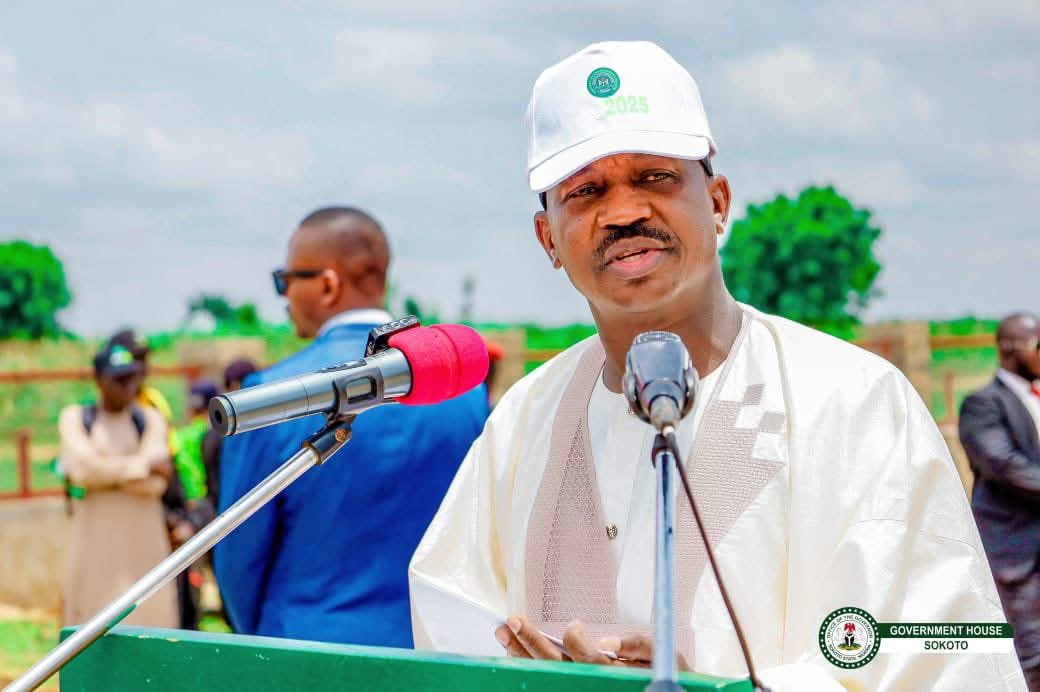
On Monday, 1st September 2025, I was elated to witness Governor Mai Mala Buni of Yobe State honour our dear Sokoto State by commissioning the rehabilitated Sokoto Geographic Information System (SOGIS) Centre. In my books, and I suspect that of many well-meaning people of our dear state, that momentous ceremony was much more than just ribbon-cutting; it was a powerful signal of our State’s commitment to digital land governance and efficient service delivery.
I read that this state-of-the-art upgrade was achieved at a cost of ₦698,404,000. I will say that it is a worthy cost to pay to bring transformative features designed for speed, transparency, and durability into land administration in our state. Automated Certificate of Occupancy (C of O) processing will now allow certificates to be delivered within two weeks, a drastic contrast to previous, drawn-out delays. Personalised applicant dashboards will ensure seamless, real-time tracking, while secure, verifiable certificates and tamper-resistant materials will enhance the integrity of land documents, placing our state among the comity of serious states.
No wonder that this enhanced system has already earned acclaim, positioning our Sokoto among the vanguard of Nigerian states leading the shift toward digital land administration. Yet, almost immediately after the ceremony, detractors have swooped in with a rallying cry that land is free, so the state should charge little to no fees for administering it. Honestly, that’s amusing at best, and misguided at worst. Where else, anywhere in the world, do you expect flawless land administration, complete with modern technology and skilled professionals, to be free? Our state didn’t just wave a wand to upgrade to SOGIS; it poured nearly ₦700 million into upgrading facilities and systems. Running a competent, tech-based operation like this carries real costs, and mandatory, competitive fees reflect that reality, not exploitation.
Look around you. In Lagos, Abuja, Port Harcourt, Enugu, Owerri, Maiduguri, Nasarawa, and pretty much everywhere, land processing comes with a price tag. Automation, speed, and security all require machinery, skilled staff, and system maintenance. In the Federal Capital Territory, for instance, the issuance fee is pegged at ₦3.5 million for all land sizes, with total costs including professional and documentation fees ranging between ₦5 million and ₦6 million, while re-certification is ₦50,000 for individuals and ₦100,000 for corporate bodies. In Edo State, the processing fee was slashed to ₦50,000, down from around ₦300,000, with a 30-day turnaround time. Nationwide, fees range from ₦100,000 to ₦500,000 depending on the region, usage, and associated services. The proposed cost for ours in Sokoto is estimated ₦100,000–₦250,000, and it, therefore, sits comfortably within the national average, and in many cases, below it.
The protests to the SOGIS fees are why I have always said that effective criticism stems from understanding, not noise. Social media may give everyone a megaphone, but knowledge is what separates meaningful critique from mere social media banter. Yes, if fees are truly exorbitant, citizens should speak up. But not when they reflect standard practices, and indeed, are in this case, even lower than those elsewhere. In a situation such as ours, the argument loses substance.
I have said it before, that when faced with the choice of choosing between a modest fee that guarantees efficiency, transparency, and security, and the old, chaotic system where documents dragged on for years, backdoor touts thrived, and official fees were eclipsed by bribes? I know I would settle for sanity, not stagnation. Everything else is just noise.
This leads me to the suspicion that those making this noise are not genuine land hopefuls. The real backlash may not even be from the people for whom the new system would really benefit. It may well stem from the land sharks who profited under the old system. You see, with automation, their under-the-table rackets vanish. No more “cin hanci”. Everything now goes through proper channels, feeding government revenue and slashing corruption. That’s precisely the kind of IGR-boosting, governance-strengthening move we want to see.
As a matter of fact, what we should be doing right now is celebrating Governor Ahmed Aliyu’s vision and courage. We should not make this a case of progress pitted against ignorance. It’s more correctly a case of progress colliding with the vested interests of a privileged few. So, instead of protests, if any, anchored on nostalgia for an exploitative system, those attacking the new system for selfish reasons should turn over a new leaf. Sokoto, and indeed, Nigerians at large, should be taking the side of and applauding forward-looking leadership. We should shut down rabble-rousers who want to fight change for their own selfish agenda.
In my books and those of many people of our dear state, the upgraded SOGIS Centre reflects a bold, necessary shift from manual, slow, opaque processes toward digital, efficient, transparent land governance. The automated C of O processing, secured certificates, and personalised dashboards exemplify this leap. The fees are reasonable and necessary, and are subject to periodic reviews. In line with, or even below, national standards. And every naira supports a system built to last. Any resistance to this change isn’t about protecting “the people”; it may well be about protecting privileges, and that won't fetch.
Let me conclude by pledging to stand with progress, with governance, and with Governor Ahmed Aliyu, a leader bold enough to make it happen. And I invite all well-meaning sons and daughters of Cibiyar Daular Uthmaniyya to come aboard this train of progress. After all, good policy deserves our applause, not the dry sarcasm of fear peddled by scaremongers.
Sani writes from Sokoto