




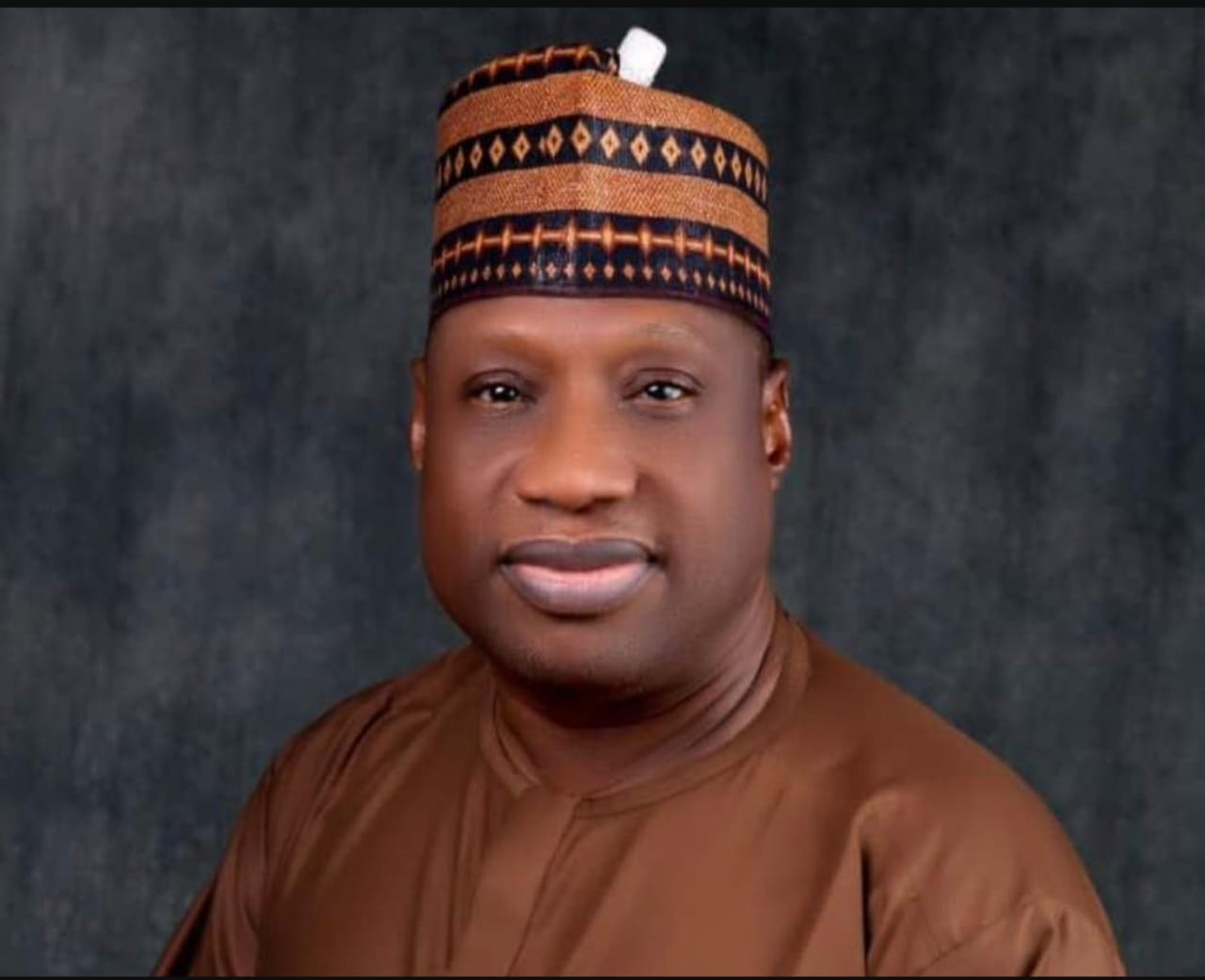
Umar Faruk: In Pursuit Of Sustainable Aviation Charges, By Musa Bala

When I read of the bombshell that the Director General of the Nigerian Airspace Management Agency (NAMA) dropped last week in Abuja, I thought it should indeed shake the foundation of Nigeria’s aviation industry. Speaking at a stakeholders’ summit convened by the House of Representatives under the theme “Emerging Trends in Global Aviation: Sustainability”, Faruk laid bare a truth that has been hiding in plain sight for far too long, the fact that Nigeria’s aviation service charges have been trapped in 2008, while airline ticket prices have skyrocketed nearly tenfold.
According to Faruk, for 17 years, NAMA has been stuck with a flat ₦11,000 per flight charge, irrespective of whether a single passenger or a full cabin of 200 passengers are onboard. In Faruk’s words:
“In 2008, NAMA was collecting ₦11,000, and I need to explain this so that the public out there will understand. When I say ₦11,000, it’s per the whole flight. I’m just giving an example. Like from Lagos to Abuja, we are charging ₦11,000 for the whole flight. That means, irrespective of the number of passengers there, we are not charging per passenger.
To fully understand the ramifications of this revelation, let us compare and contrast the charge with the reality on ground today. In 2008, an economy class ticket from Lagos to Abuja hovered below ₦20,000. Today, the same route costs anywhere between ₦150,000 and ₦200,000, or even higher in peak seasons. Yet, NAMA, the backbone agency keeping Nigeria’s skies safe, modern, and navigable, is still confined to the 2008 aviation charge when flights cost a fraction of what they cost today.
“From 2008 to date, you and I know that they are collecting almost ₦150,000, or it’s hovering between ₦150,000 and ₦200,000 economic ticket, and yet we are still where we were, ₦11,000. Given the fact that we are cost recovery agents, we are supposed to recover from what we have invested. We’ve invested hugely in procuring improved landing systems, surveillance systems, and communication systems, and yet we keep modernising. We keep moving with the technology so that we will not be left behind, and yet you are still paying us peanuts. I think the world needs to know, and the airlines need to face the reality of life. We cannot continue this way.” he revealed.
To widen the scope of Faruk’s revelations, I did some findings where I compared aviation charges across Africa in 2008 and now. This comparative review of service charges across Africa paints a disturbing picture of how Nigeria lags behind.
In Kenya, air Navigation Service Charges were reviewed twice between 2008 and 2022, moving from the equivalent of $50 per domestic flight to tiered rates averaging $150–$200, depending on aircraft size. Similarly, South Africa service fees per flight have increased steadily, with air navigation charges climbing from $70 in 2008 to about $250–$300 today.
Our west African neighbour, Ghana are also not left out in reviewing aviation charges. The Ghana Civil Aviation Authority has moved charges from about ₦15,000 equivalent in 2008 to over ₦60,000 equivalent per domestic flight by 2023.
This is why I stand with Umar Faruk that Nigeria’s ₦11,000 charge is no longer sustainable. As a matter of fact, this stagnation is not only unsustainable, it is a threat to aviation safety. Everyone knows that aviation is a capital-intensive industry. Navigational aids, radar surveillance, communication upgrades, and landing systems cost millions of dollars to acquire, install, and maintain. And since Nigeria does not buy her equipment from a different market, it simply means that the burden of cost has been shifted to other avenues. This means that by refusing to adjust charges to reflect modern realities, airlines may enjoy short-term relief, but the long-term result, especially when the source of funding dries up, will be weakened aviation infrastructure, a risk that affects everyone who boards a plane in Nigeria.
Umar Faruk highlighted what those of us who practically live in the skies rarely consider; the hidden systems that keep us safe in the skies. From advanced landing systems that guide pilots through foggy runways, to radar surveillance systems that track aircraft across Nigerian airspace, to communication systems that ensure pilots and controllers are always in sync, it’s the job of NAMA to provide us the unseen safety net. And it goes without saying that each of these systems is expensive to purchase, install, and upgrade, and yet the agency is expected to function with fees that were pegged before smartphones became common in Nigeria.
Putting his frustration to words, Umar Faruk revealed that “We have made several attempts to draw the attention of the airlines. There’s a need for us to sit down. It’s been a part of our requirement that we should engage them, discuss with them, and let them see the reason why we must review these charges.”
But the airlines, according to Faruk, have not been cooperative.
“The truth of the matter is that the airlines have not been fair to the agency because we are not a charity organisation. We are a cost recovery agency, and yet, they have been responding to prevailing economic situations, and yet they don’t want to understand that we also go to the same markets. We procure this equipment hugely, and, therefore, there’s what you call cost recovery.”
Here then is my surprise. I mean, why should the airlines who should understand the situation not see why a review of aviation service charge is inevitable? Seriously, it is difficult to justify why airlines, who have increased ticket fares by nearly 700% since 2008, resist a corresponding adjustment in service charges paid to NAMA. Airlines operate as businesses, adjusting their fares to reflect jet fuel costs, exchange rates, and inflation. Why then should NAMA, the custodian of air safety, which should be adjusting air service charges to reflect the skyrocketing price of equipment and maintenance remain stuck with outdated charges that could barely cover the cost for obsolete models of aviation equipment?
My happiness is that Faruk was clear-eyed and bold enough to spell out what is at stake when he told the stakeholders that his focus is first to “recover what we (NAMA) have invested in their own services so that safety is not compromised. Unfortunately, the airlines want to continue paying peanuts while they are charging the right, appropriate fare for their services. But they don’t want to pay the appropriate fees for our charges.”
This is why the Nigerian travelling public should be concerned. If NAMA is starved of revenue, it cannot invest in modern systems. And if it cannot modernise, aviation safety will be compromised. This is not rocket science. And at that point, the cheap charges the airlines think they are enjoying will mean nothing if passengers lose confidence in Nigerian skies.
My happiness stems from the fact that it was not only Faruk who underscored the urgency of reform. The Chairman of the House Committee on Aviation, Abdullahi Garba, represented by his deputy Festus Akingbaso, stressed that collaboration between regulators and airlines is vital.
“Our goal is to develop actionable plans and reinforce priorities that enhance aviation safety, infrastructure and regulatory compliance.” he declared
And I say, this alignment between the legislature and NAMA should be seized upon. It offers an opportunity for long-overdue reforms that balance fairness with sustainability. If other African nations have seen the need to pursue necessary changes to aviation charges, I wonder why we should be left behind.
Let me conclude by stating without mincing words that the challenge is not whether service charges should be reviewed, it is how quickly Nigeria can correct this 17-year anomaly as delay could be dangerous. A fair adjustment does not mean stifling the airlines; it means recognising that NAMA cannot fund 21st-century aviation systems with 2008-era fees. Very simple.
The airlines must face the reality that safety is not negotiable. A system that allows them to charge passengers market-reflective fares while refusing to pay market-reflective charges to NAMA is neither fair nor sustainable.
Faruk’s intervention is timely, bold, and necessary. His words have thrown the spotlight on a systemic imbalance, and for the sake of the industry, passengers, and Nigeria’s place in global aviation, his call must not be ignored.
The aviation sector is the lifeline of modern economies. It carries not only passengers but also trade, investment, and reputation. If Nigeria is serious about remaining a major hub in West Africa, then the infrastructure that powers its aviation must be sustainably funded.
We must commend Umar Faruk for doing what many in his position might shy away from. He has taken the bull by the horn to say the truth without sugarcoating it. The charges must be reviewed. The airlines must come to the table. And the Nigerian public must understand that a safe, modern airspace is not built on peanuts but parity and sustainability.
I’m elated that for once, the conversation is no longer about excuses. It is about reality. And the reality is this: the cost of flying has changed, and so must the charges that keep our skies safe. Anything short of this amounts to corporate sabotage and armed with Faruk’s revelations, Nigerians must demand safety over lip service.
Bala writes from Abuja
