




I’m writing this piece with a painful grimace on my face. It is rather unfortunate, painful, and frankly disrespectful that a sections of the media have again chosen Sokoto state to paint with a dark brush as a land where nine out of every ten persons live in multidimensional poverty. Such wild conclusions about the same Sokoto that we live in, that we see people thriving everyday in their chosen pursuits, may make for sensational headlines, the bane of today’s journalism. However, it does little to reflect the current reality on the ground, nor does it honour the painstaking efforts being made to lift the people of Sokoto out of economic distress. Let me state upfront that while I don’t speak for the current government of Ahmed Aliyu, it is pertinent to reveal here that the administration of Governor Aliyu has, in just a little over a year, rolled out interventions that have focused more on human capital development, economic inclusion, and social protection than the misleading statistics being circulated.

I agree that data, or facts, which are products of methodologies, do not pander to emotions. So, we must be afforded the opportunity to query the methodology that birthed the data upon which the rash conclusions in that report have been reached. Sokoto does not lack social science scholars who will query such works. In fact, the state government has commissioned a survey on the multidimensional poverty index in Sokoto, the purpose of which was to understand the situation and find solutions.
One of the solutions being readied by Aliyu-led government ahead of the conclusion of the survey is Agriculture. One cannot talk about poverty alleviation without talking about agriculture, the backbone of the rural economy of Sokoto state. Since assuming office, Governor Aliyu has twice distributed fertilizer free of charge to farmers across the state. Free seedlings, essential farm inputs, and implements followed, all at no cost to the farmers. This tells you that Aliyu’s is not a government waiting for applause; it is one rolling up its sleeves to ensure that farming households produce more, spend less, and by extension, have a fighting chance against hunger and deprivation. If the so-called poverty index had looked closely at the timing and impact of these interventions, it would have found a narrative of resilience rather than ruin.
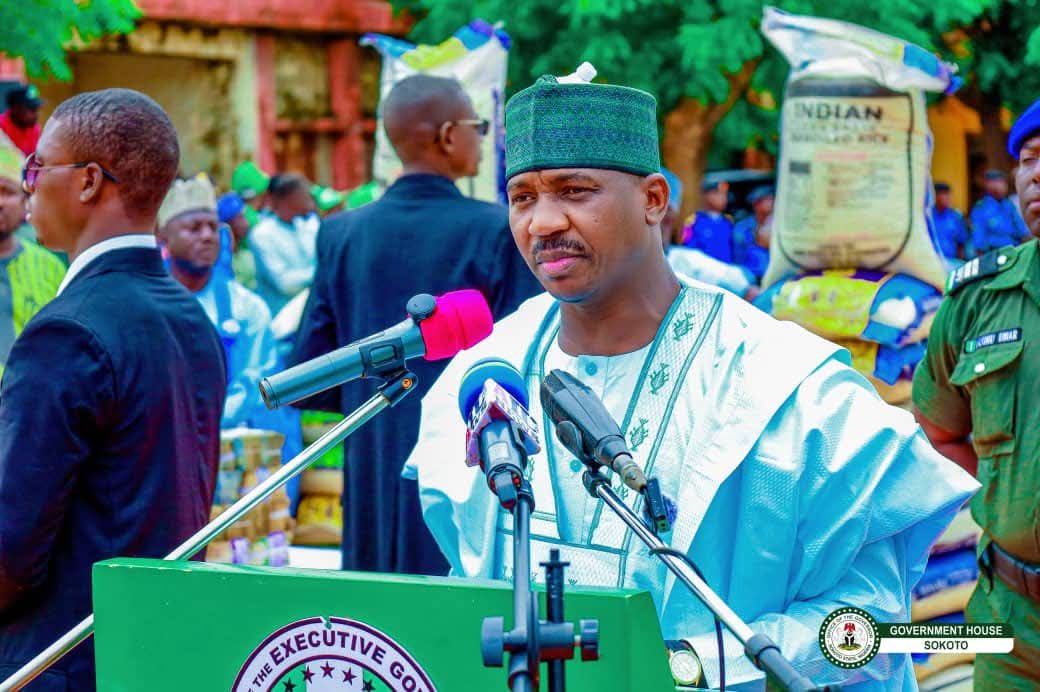
Equally important is the attention given to the most vulnerable members of society. I’m aware that on several occasions, Aliyu’s government has distributed food assistance under its palliative programme to the physically challenged, vulnerable households, imams, their deputies, and muazzins. I know that these distributions were not empty photo opportunities because many beneficiaries are known to us. Aliyu’s interventions have always been targeted lifelines, especially at times when national economic pressures were bit hardest. And where the previous administration turned its back, this one chose restoration. The monthly allowance for the physically challenged, introduced during the Wamakko era and cruelly abandoned by the immediate past administration, has not only been revived but reviewed upward. This is what real social protection looks like. It is quiet; perhaps too quiet, yet consistent, and life-changing for those who have long been ignored.
In Sokoto today, Aliyu is not only working to restore dignity to individuals, but also to institutions that form the fabric of our communities. For the first time in the history of the state, Jumu’at mosques receive monthly cash allocations, with Grade A mosques getting as much as half a million Naira. These monies go into supporting those carrying out the very important work of inculcating values in our society through religion.
Ministries, departments, and agencies (MDAs) that were hitherto starved of operational funds for nine straight years now receive their monthly allocations promptly. Retirees, who were left stranded with unpaid gratuities running into billions of naira, have found relief as the governor set aside billions of Naira to clear the backlog and has committed to releasing ₦500 million monthly for that purpose. On top of that, ₦300 million is reserved monthly to pay those retiring during his tenure, ensuring no one goes home after years of service to meet empty promises.
We have seen, since Aliyu took over, that human capital development is not an empty phrase in his workbook; it is manifest in the regular and timely payment of salaries between the 19th and 20th of every month, a far cry from the days when workers could not tell if their pay would come on the 15th of the following month or not at all. It is seen in the recruitment of teachers, the improvement of primary healthcare facilities, and the scholarships awarded to indigent students to pursue tertiary education. It is felt in the improved water supply that has seen Sokoto move away from the shameful days when a jerry can of untreated river water sold for as high as ₦200 because the previous government failed to provide treatment chemicals. Contracts have been awarded for the completion of major waterworks in Gagi, Old Airport, Mana and Tamaje to complement the Sokoto Water Board’s supply, further guaranteeing access to clean, treated water for households and businesses.
The administration has not borrowed a dime, either from within or outside the country, to finance these interventions. It does not owe contractors; it pays as soon as projects are certified. Over 110 projects have been executed in one year alone. These include roads, mass transit schemes, streetlights, and city beautification that have restored daily cleanliness to Sokoto city after years of decay. Solar-powered streetlights now light up not just the metropolis but also the local government areas, making nights safer and commerce more vibrant.
I’m also aware that Aliyu’s government has taken bold steps in security and mobility, two key enablers of any meaningful economic recovery. Over 120 patrol vehicles have been distributed to security agencies, with the military receiving the lion’s share to combat armed banditry. The Sokoto State Community Guard Corps, made up of trained youths drawn from the 13 most affected local government areas, now operates with 40 Hilux patrol vans, over 700 motorcycles, and newly established headquarters at both state and local government levels. Just recently, the governor provided an additional 10 vehicles to the military to sustain patrol operations. On the transport front, 110 mass transit buses have been procured for interstate and intra-city services, with Toyota Camry sedans set aside for women-only transportation. Another 1,000 motorcycles and 500 tricycles are being provided to youths at subsidised rates to boost intercity transport and create livelihoods. Are these not poverty reduction approaches?
No, these are not the actions of a government presiding over a wasteland of poverty and despair. They are the hallmarks of a government that understands that poverty is multidimensional, yes, but so is development. From paying gratuities that restore the dignity of the elderly to funding palliatives that keep food on the table for the poorest, from cleaning the streets to lighting up the nights, from empowering farmers to subsidising transport for young entrepreneurs, Sokoto under Ahmad Aliyu is charting a new course.
This, then, is why I have been disturbed by that report. I think these people need to be told that when a report casually throws up a figure that nine out of every ten people here live in multidimensional poverty, it does more than raise eyebrows and serves as a clickbait; it insults the intelligence of a people who can see, feel, and measure the change in their own lives. It discounts the teachers who now teach with renewed motivation because their salaries come on time. It erases the farmers who now cultivate with free inputs. It ignores the physically challenged who now receive more than a token to survive. It turns a blind eye to the young men and women trained and deployed to guard their own communities against banditry. And it dismisses the small but significant progress being made every single day in households from Gagi to Mana, from the old airport to the Tamaje area.
Poverty is a stubborn adversary; no one is saying Sokoto has defeated it entirely. But there is a difference between acknowledging challenges and weaponising them to paint a state as failed. The media owes the people of Sokoto a duty of fairness, and fairness begins with balance. Balance asks: what has been done, what is being done, and what remains to be done? I’m not one to sing praises, but we must appreciate those who are trying their modest best, and Governor Aliyu’s administration is doing its part. It is changing the narrative one intervention at a time. It has refused to lament the sorry state it met our dear state; he has elected to just act. Aliyu is paying, building, distributing, training, lighting, cleaning, and restoring. And if this is not the kind of leadership that deserves a fair hearing, then what is?
For those who care for balance, fairness, and objectivity, please hear me. Sokoto is not a land of hopelessness. It is a state on a path of gradual, deliberate recovery. Governor Aliyu is finding a way, one policy, one project, and one intervention at a time. So, those who wish to tell its story must be prepared to tell the full story, not the convenient fragments that fit a preconceived narrative. Of course, more is expected and more can be done, but to suggest hopelessness in the manner it was alleged is murder.
Aminu writes from Sokoto.
